
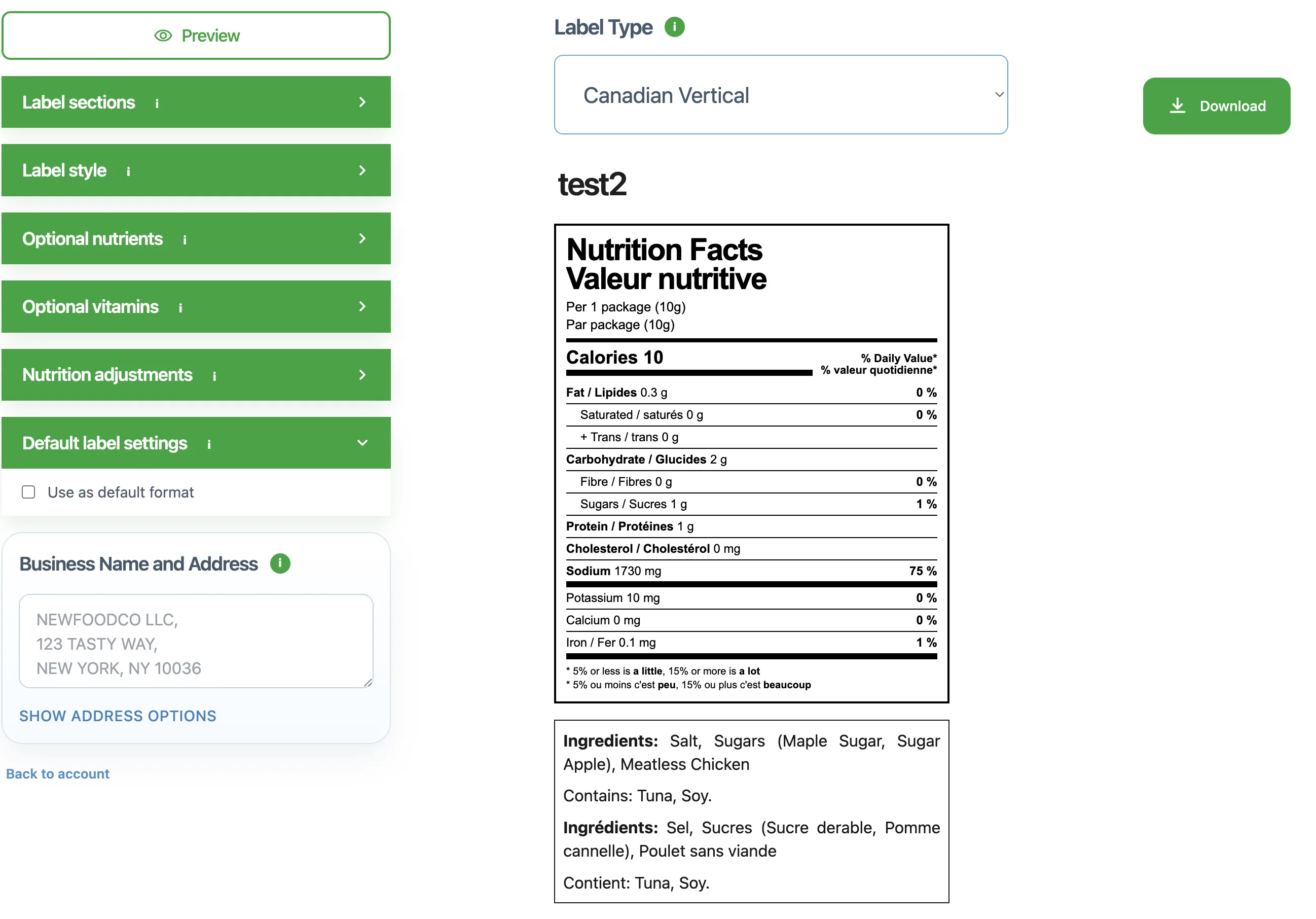
Key takeaway
Canadian label review should treat the Nutrition Facts table, serving details, ingredient list, allergen declarations, and packaging text as one connected review package.
Treat Canada as its own label review workflow
A Canadian Nutrition Facts label is not just a U.S. Nutrition Facts panel with small wording changes. Canadian label review has its own Nutrition Facts table expectations, serving-size review, format considerations, ingredient-list rules, and allergen-related declaration requirements.
For small food teams, the safest workflow is to treat Canada as a separate market review. Start with the current recipe and serving plan, then review the Canadian table and surrounding packaging text together before export.
- Confirm that the product is being reviewed for Canadian packaging
- Keep Canadian table review separate from U.S. FDA-style assumptions
- Review supporting statements with the same recipe version as the table
Review the Nutrition Facts table content and format
Canadian Food Inspection Agency materials describe the Nutrition Facts table as carrying specified nutrition information for prepackaged products, with prescribed order, dimensions, spacing, letter case, and bold type requirements tied to the applicable format.
That means the review should cover more than the numbers. Serving details, nutrient declarations, format choice, and presentation rules all need attention before a Canadian table is treated as packaging-ready.
- Review serving-size logic before approving per-serving values
- Check nutrient declarations and percent Daily Value fields in the Canadian context
- Confirm that the selected table format fits the package and rule set being used
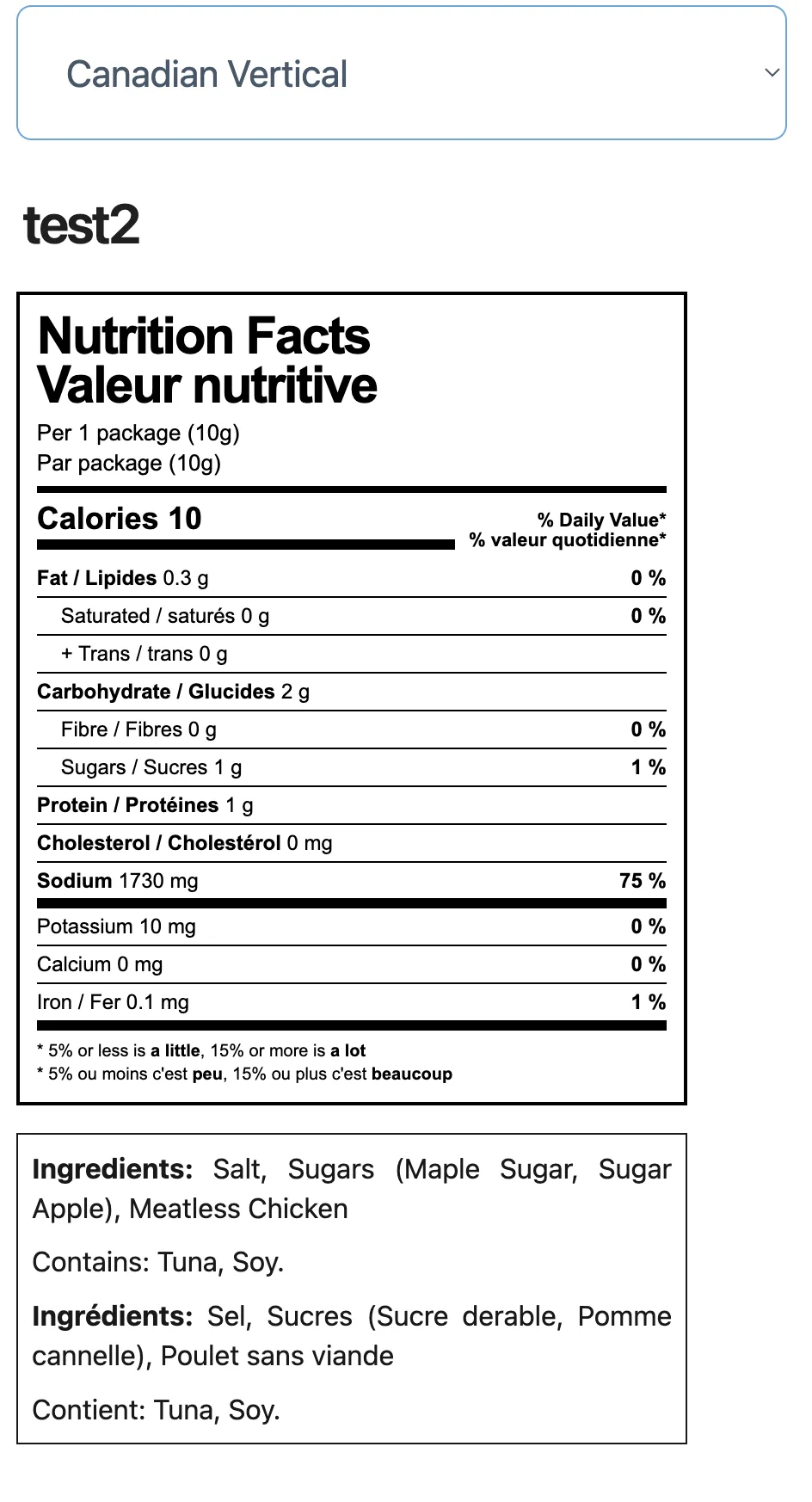
Focused view: Canadian table and statements
This close view keeps the Canadian Nutrition Facts table and the supporting ingredient and allergen statements in one review frame.
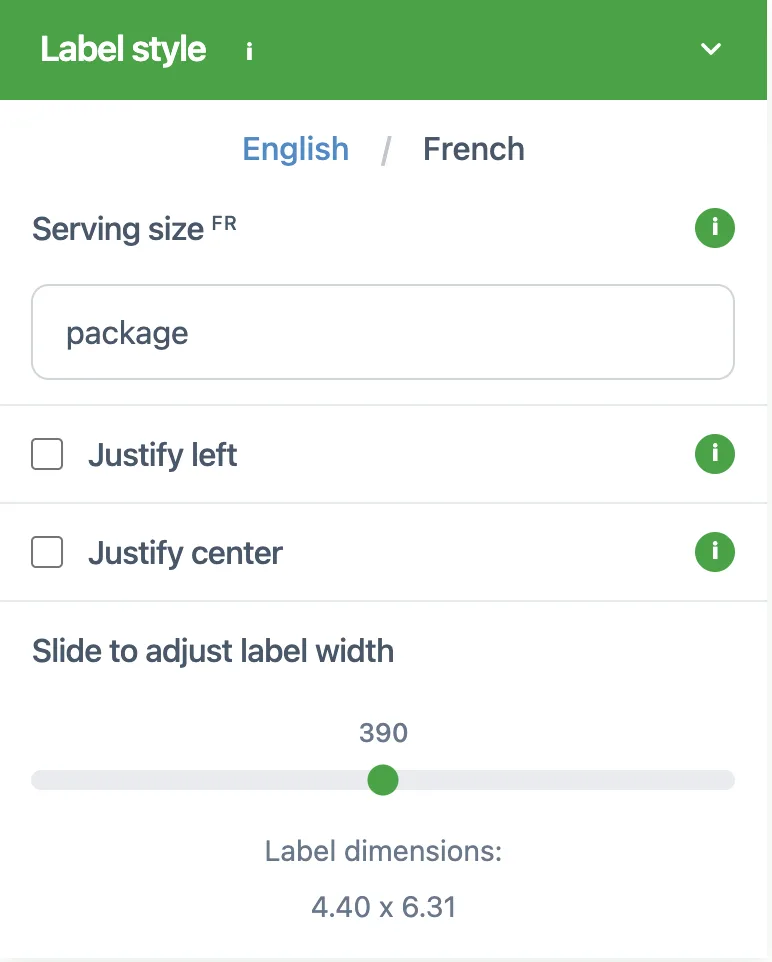
Focused view: bilingual settings
Canadian label review includes bilingual serving wording and presentation controls, not just the nutrient values inside the table.
Review ingredient, allergen, gluten, and sulphite declarations
Canadian label review also needs the packaging text around the Nutrition Facts table. CFIA guidance says food allergens, gluten, and added sulphites must be declared when required and no exemption or exception applies.
Because these declarations depend on the same underlying recipe and supplier details, they should be reviewed near the ingredient statement and Nutrition Facts table rather than as a late packaging cleanup task.
- Check ingredient wording against the active recipe version
- Review priority allergens, gluten sources, and added sulphites in the Canadian context
- Keep precautionary cross-contamination statements separate from required declarations
Use the workspace as a review surface, not a final authority
A workspace can help organize recipe values, label settings, statements, and review notes, but it does not replace qualified regulatory review. This is especially important when a product crosses markets or when the packaging will be printed at scale.
Use the tool to keep the review pieces aligned, then have the final Canadian packaging assessed against the applicable requirements before making production decisions.
- Use the workspace to keep recipe and statement versions aligned
- Do not treat a preview as official Canadian approval
- Escalate final packaging review to qualified Canadian labeling expertise when needed
Common mistakes
- • Assuming a U.S. Nutrition Facts workflow automatically satisfies Canadian label review
- • Reviewing the Canadian Nutrition Facts table without checking serving-size and format rules
- • Leaving allergen, gluten, sulphite, or ingredient-list review outside the final packaging check
Review checklist
- • The product is being reviewed for the Canadian market, not only a U.S. label workflow
- • Serving size, nutrient values, and format choices are checked against Canadian requirements
- • Ingredient list, allergen, gluten, and sulphite declarations are reviewed together
- • The final label is reviewed by a qualified person before packaging or print decisions
FAQ
Can I reuse a U.S. Nutrition Facts label for Canada?
Do not assume that. Canadian Nutrition Facts table and packaging review should be treated as a separate workflow with Canadian serving, format, nutrient, ingredient, and allergen requirements in mind.
What should I review first for a Canadian label?
Start with the current recipe, serving plan, and market context. Then review the Nutrition Facts table, ingredient list, allergen details, gluten sources, sulphites, and nearby packaging text together.
Are Canadian allergen declarations the same as U.S. declarations?
No. The review sets overlap but are not identical. Canadian review should account for Canadian priority allergens, gluten sources, and added sulphites where applicable.
Does the workspace approve my Canadian label?
No. The workspace can help organize review, but final Canadian packaging decisions should be checked against applicable requirements by qualified reviewers.
Related guides
How to Choose a Nutrition Facts Label Format
A practical guide for comparing Nutrition Facts label formats before a food label moves into packaging review.
What Is a Net Quantity Statement? A Practical Guide for Food Labels
Net quantity is the amount of product in one retail package. Keep it separate from the serving plan, servings per container, and total recipe yield.
FDA Nutrition Label Requirements: What Small Food Brands Should Review
A practical review guide for understanding FDA-style Nutrition Facts label structure, nutrition label requirements, and common mistakes.
How to Make a Nutrition Facts Label
A step-by-step guide for small food brands learning how to make a nutrition label and turn recipe data into a Nutrition Facts label preview.
How to Write an Allergen Statement
A practical guide for drafting an allergen statement that stays aligned with the current recipe, ingredient statement, and label review workflow.
How to Write an Ingredient Statement
A practical guide for turning the active recipe into a review-ready ingredient statement that stays aligned with the label and surrounding packaging text.