
Key takeaway
A small business exemption may apply to Nutrition Facts labeling only when the specific firm, product, sales-volume, and claims facts meet the current FDA conditions. It does not remove the rest of the package-label review.
Short answer: maybe for Nutrition Facts labeling, not for the whole package
A small food business may be able to use an FDA small business Nutrition Facts labeling exemption when the product and firm meet the applicable conditions in the current rule and FDA instructions. The answer is product-specific and fact-specific, so a business should not treat its size alone as proof that every product is exempt.
Even when a Nutrition Facts exemption is available, it does not automatically remove ingredient-list, major-allergen, identity, net-quantity, or other packaging obligations. Those requirements need their own review for the product and market.
- Review Nutrition Facts exemption status separately from the rest of the package
- Use current FDA and eCFR instructions for the product and firm facts
- Keep a label-preparation path available if the exemption is uncertain or does not apply
Collect the low-volume facts before deciding
The low-volume exemption review depends on facts about the firm and the specific product, not a rough description such as “we are a small company.” Start by documenting the firm's average full-time-equivalent employees and the number of units of the product sold in the United States during the relevant 12-month period. Keep the product name, package details, firm identity, and review period together so the evidence can be checked later.
Also check whether nutrition or health claims appear on the label, website, advertisements, or other promotional material. Claims can change the exemption analysis, which is why the review should cover the actual product presentation rather than only the recipe or sales spreadsheet.
- Average full-time-equivalent employees for the firm
- U.S. units sold for the specific product during the relevant period
- Firm and product details that identify exactly what is being reviewed
- Nutrition and health claims in labeling and advertising
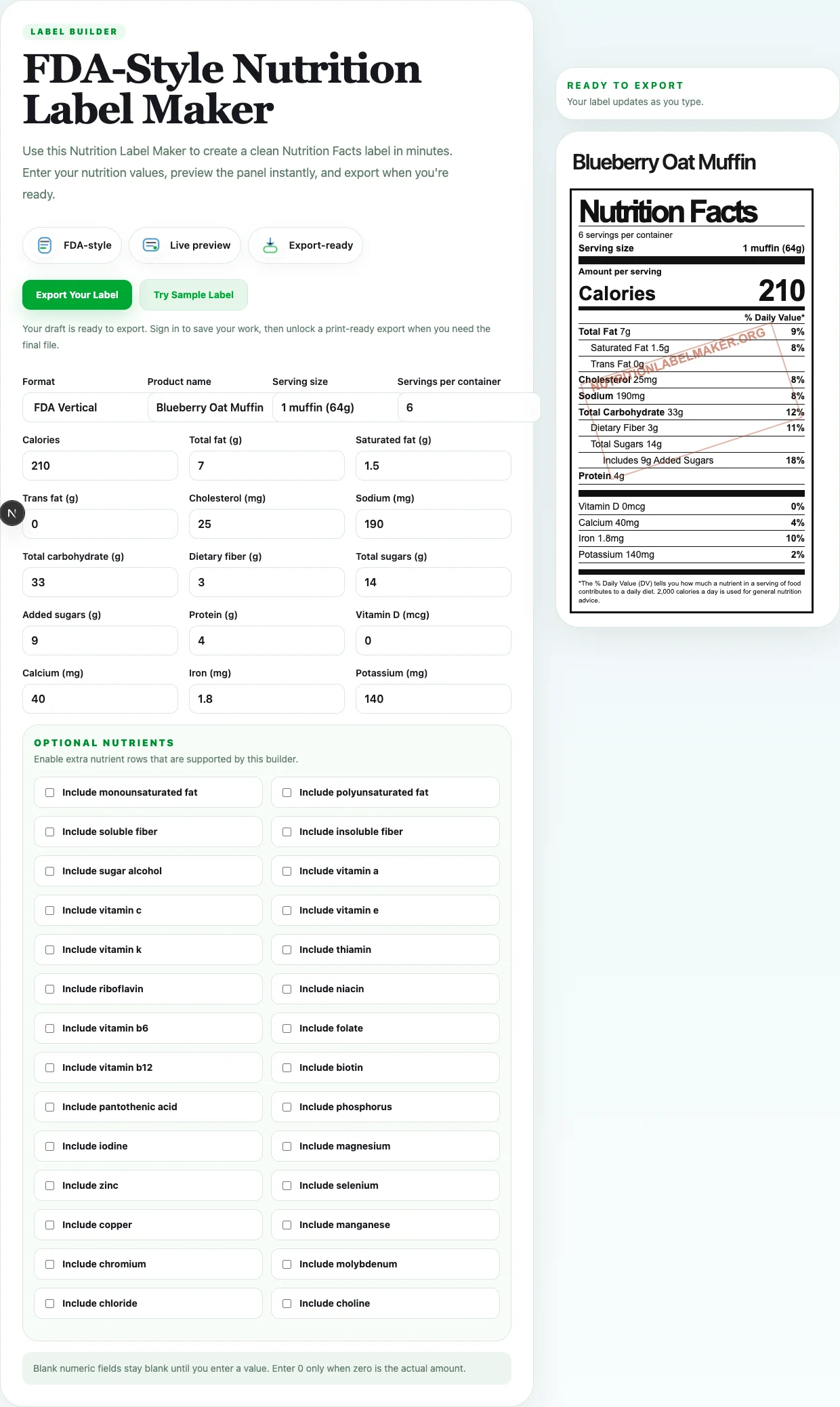
Fallback workflow: prepare the Nutrition Facts panel
Actual current product UI: use this workspace to prepare or review a Nutrition Facts label if the exemption is unavailable or still uncertain. It is not an exemption eligibility checker.
Understand the notice path without copying an old form workflow
Some small business Nutrition Facts exemptions require an annual notice to FDA, while other situations may not require the same notice path. The distinction depends on the exemption category and the current official instructions. Do not infer the answer from an old filing, a forum post, or another product's paperwork.
Use FDA's current Small Business Nutrition Labeling Exemption Guide and Notice Model Form to confirm whether a notice applies, what information is required, and how often the business must update it. If the instructions or fact pattern are unclear, pause and obtain qualified regulatory review before treating the exemption as active.
- Confirm the applicable exemption category first
- Check the current FDA notice instructions and timing
- Keep a dated copy of the facts and source pages used for the review
Common failure modes for small businesses
The most common mistakes come from using an imprecise fact pattern. A company may count total sales instead of product-specific units, overlook claims in advertising, or assume that a notice prepared for one product covers the entire catalog. Another frequent problem is carrying forward a notice or threshold from an older source without checking the current FDA page.
Treat each product as its own review record. When the firm, product volume, claims, package, or market changes, reopen the analysis and keep the decision connected to the evidence used.
- Do not substitute total company revenue for product-specific unit volume
- Do not ignore claims because they appear outside the package
- Do not reuse one product's exemption decision for a different product
- Do not rely on an undated or copied notice
Use a three-outcome self-check
A self-check is useful for organizing the next step, but it is not an eligibility determination. Compare the current product and firm facts with the official sources, then choose the workflow that matches the evidence. If a condition is uncertain, treat the result as “investigate,” not as an exemption.
If the business does not qualify, cannot document the conditions, or chooses not to rely on the exemption, proceed with Nutrition Facts label preparation. A connected workspace can help organize recipe data, serving details, and the label draft, but it cannot prove that an exemption applies.
- Investigate with current FDA and eCFR sources when a condition is unclear
- Prepare the required annual notice when the applicable exemption category calls for one
- Proceed with Nutrition Facts label preparation when the exemption is unavailable, uncertain, or not being used
Common mistakes
- • Using total company sales instead of the units sold for the specific product under review
- • Ignoring nutrition or health claims in labeling or advertising when reviewing eligibility
- • Copying an old exemption notice or assuming a notice is still current without checking FDA instructions
- • Assuming one product's exemption status automatically applies to every product sold by the firm
Review checklist
- • The product and firm are being reviewed against current FDA and eCFR instructions
- • Average full-time-equivalent employees and product-specific U.S. unit volume are documented for the relevant period
- • Nutrition and health claims in labeling and advertising have been checked
- • Other package obligations remain in scope, including ingredients, allergens, identity, and net quantity
- • The team has chosen one of three next steps: investigate, prepare a notice if applicable, or proceed with label preparation
FAQ
What does the FDA small business exemption cover?
It may provide an exemption from Nutrition Facts labeling for a specific product when the current conditions are met. It is not a blanket exemption from ingredient, allergen, identity, net-quantity, or other package-label requirements.
Does every small food business qualify for a Nutrition Facts label exemption?
No. Eligibility depends on the firm, product-specific volume, employee information, claims, and the applicable exemption category. Confirm the current facts against FDA instructions instead of relying on company size alone.
Do I always need to file an FDA exemption notice?
Not necessarily. Some exemption paths require an annual notice, while other situations may not use the same notice requirement. Check the current FDA guide and model form for the category that applies to the product.
What happens if my product uses nutrition or health claims?
Claims can affect the exemption analysis. Review claims in labeling and advertising as part of the product fact pattern, and obtain qualified review before relying on an exemption.
Official sources
Related guides
FDA Nutrition Label Requirements: What Small Food Brands Should Review
A practical review guide for understanding FDA-style Nutrition Facts label structure, nutrition label requirements, and common mistakes.
How to Make a Nutrition Facts Label
A step-by-step guide for small food brands learning how to make a nutrition label and turn recipe data into a Nutrition Facts label preview.
How to Calculate Nutrition From a Recipe
A practical guide for turning recipe ingredients, batch yield, and serving logic into per-serving nutrition values that are ready for label review.
How to Choose a Nutrition Facts Label Format
A practical guide for comparing Nutrition Facts label formats before a food label moves into packaging review.
How to Write an Ingredient Statement
A practical guide for turning the active recipe into a review-ready ingredient statement that stays aligned with the label and surrounding packaging text.
How to Write an Allergen Statement
A practical guide for drafting an allergen statement that stays aligned with the current recipe, ingredient statement, and label review workflow.
What Is a Net Quantity Statement? A Practical Guide for Food Labels
Net quantity is the amount of product in one retail package. Keep it separate from the serving plan, servings per container, and total recipe yield.