
Key takeaway
Useful allergen wording starts with the active recipe and supplier details. Treat examples as a way to organize review, then confirm the final declaration for the product, market, and manufacturing context.
Start with two declaration paths, not one copy-and-paste template
For U.S. food-label allergen review, a practical starting point is to make the relevant allergen source clear in the ingredient list, use a Contains statement adjacent to that list when it fits the review approach, or review both together. The correct final declaration depends on the active formula, supplier details, product, market, and applicable requirements.
This guide uses examples to make the review questions visible. It does not give you a universal line to copy onto a package, because a statement that fits one product can be incomplete or misleading for another formula.
- Start from the active recipe and current supplier specifications
- Treat the ingredient list and a Contains statement as connected review surfaces
- Keep the final compliance decision with an appropriately qualified reviewer
Use examples to spot allergen sources in the ingredient list
Illustrative ingredient-list examples can help a team see the source name that needs attention: whey (milk), lecithin (soy), and flour (wheat). The parenthetical source is useful because the packaging reviewer can compare it directly with the ingredient that appears in the active formula.
A compound ingredient can add another layer. For example, an illustrative chocolate-chip entry may include sugar, chocolate liquor, cocoa butter, soy lecithin, and vanilla. The point is not to reuse that exact line. The point is to ask whether the purchased chocolate chips and their current supplier specification introduce a relevant source that needs review.
- Use the exact product and supplier information, not a generic memory of the ingredient
- Review every compound ingredient, blend, sauce, coating, or premix for subingredients
- Keep illustrative examples clearly separate from final package wording
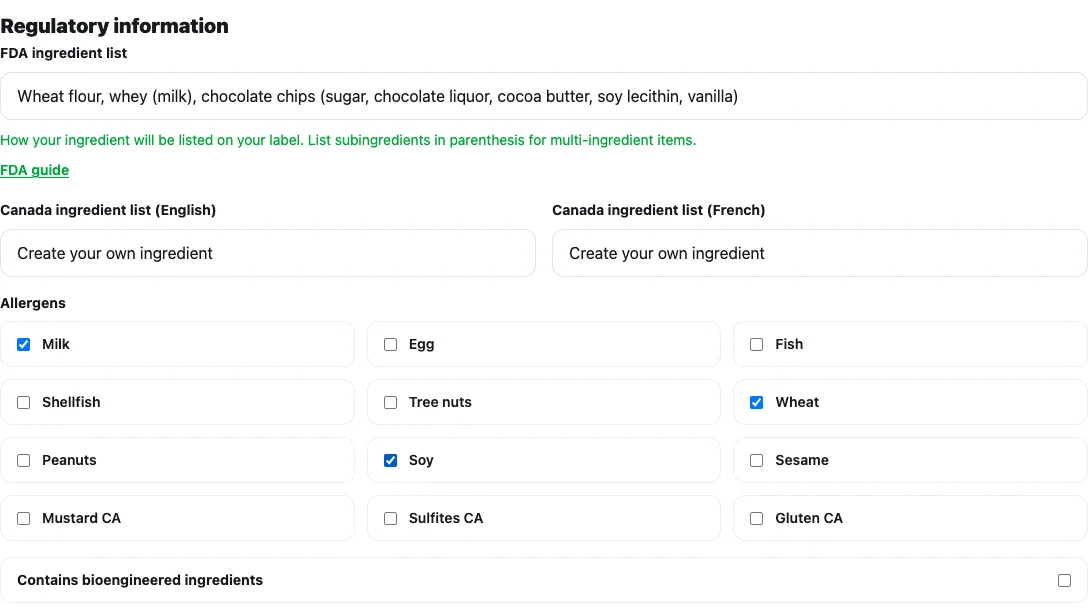
Actual allergen-source review screen
Use the active formula and current supplier information to review the ingredient line and selected allergen sources together. The example shown here was entered only for this screenshot and was not saved.
Review a Contains statement against the full ingredient set
A Contains statement can make the relevant major allergen sources easier for a customer and packaging reviewer to see near the ingredient list. An illustrative example is: Contains: Milk, Egg, Soy. Before using a statement like that, review the complete current ingredient and subingredient set rather than selecting only the most obvious source.
The useful question is not whether a short line looks familiar. It is whether the statement and ingredient list both reflect the same current product. When a recipe, supplier formulation, or component ingredient changes, reopen the review instead of carrying a previous Contains line forward unchanged.
- Compare each proposed source with the active ingredient and subingredient review
- Do not rely on a Contains line copied from an older label
- Recheck the statement after formula or supplier changes
Give compound ingredients and source-specific allergens extra attention
Some ingredient names are broad enough to hide the detail a package reviewer needs. Fish, crustacean shellfish, and tree nuts are examples where the specific source may matter to the declaration review. That is why supplier specifications and current official guidance should stay close to the packaging work.
For a seasoning blend, sauce, chocolate chip, or other purchased component, review the parent item and its subingredients before deciding that the allergen work is complete. The safe workflow is evidence first: current product documentation, current formula, then qualified final review.
- Flag fish, shellfish, and tree-nut source details for focused review
- Ask suppliers for current component and allergen documentation when needed
- Do not assume a familiar product name tells the whole allergen story
Keep intentional allergen declarations separate from precautionary language
A source intentionally present in the recipe is a different review question from possible cross-contact in a shared facility or production line. Precautionary language, including may-contain wording, should not be used as a shortcut for reviewing the ingredients that are actually part of the food.
Keep manufacturing, supplier, and facility context available when precautionary wording is being considered. Review it separately from the ingredient-based declaration, and have the relevant qualified reviewer decide the final wording for the product and market.
- Declare intentional ingredient allergens through the applicable ingredient-list review
- Treat cross-contact and facility claims as a separate risk and wording review
- Do not use precautionary language to cover an incomplete ingredient statement
Finish with one connected package review before export
Before a packaging file is exported, compare the ingredient statement, allergen selections, any Contains wording, Nutrition Facts label preview, and nearby package text against the same active recipe version. This reduces the chance that the formula moved forward while an older allergen line remained in the artwork.
A workspace can keep those related inputs organized, but it cannot certify the package. If the source, wording, or applicability is uncertain, stop at review and consult current official guidance and an appropriately qualified person before printing or selling the product.
- Confirm the formula and supplier documents used for the review
- Check ingredient wording, allergen sources, and any Contains line together
- Keep the final regulatory decision with the appropriate qualified reviewer
Common mistakes
- • Copying a Contains statement from another product without checking the current formula and subingredients
- • Using precautionary or may-contain language instead of declaring allergens intentionally present in the food
- • Reviewing only a parent ingredient name while missing an allergen source inside a compound ingredient
- • Leaving the ingredient list and allergen review on different recipe versions
Review checklist
- • The current recipe and supplier specifications are the source for allergen review
- • Ingredient-list wording makes relevant allergen sources visible where applicable
- • Any Contains statement is checked against the full current ingredient and subingredient review
- • Precautionary wording is reviewed separately from intentional ingredient allergens
- • The ingredient statement, allergen details, and label preview reflect the same product version
FAQ
Can I show an allergen source in parentheses in the ingredient list?
Parenthetical wording can make an allergen source visible beside an ingredient, as in illustrative examples such as whey (milk) or lecithin (soy). Review the final declaration against the active formula, supplier information, and applicable official requirements.
Should a Contains statement be checked against every ingredient?
Yes. Treat the complete active ingredient and subingredient review as the source for any Contains statement. A short line should not be copied from an earlier package or based only on the most obvious ingredients.
Is may-contain wording the same as a Contains statement?
No. Precautionary wording concerns possible cross-contact, while a Contains statement is reviewed alongside allergens intentionally present in the formula. Keep those decisions separate.
When should I update an allergen statement?
Re-review it when the recipe, supplier ingredient, subingredient, manufacturing context, or target market changes. Compare the final wording with the ingredient list and label preview before export.
Official sources
Related guides
How to Write an Allergen Statement
A practical guide for drafting an allergen statement that stays aligned with the current recipe, ingredient statement, and label review workflow.
How to Write an Ingredient Statement
A practical guide for turning the active recipe into a review-ready ingredient statement that stays aligned with the label and surrounding packaging text.
In What Order Should Ingredients Be Listed on a Food Label?
A practical U.S. food-label review guide for checking ingredient list order, subingredients, and small-quantity declarations against the active product formula.
FDA Nutrition Label Requirements: What Small Food Brands Should Review
A practical review guide for understanding FDA-style Nutrition Facts label structure, nutrition label requirements, and common mistakes.
Canadian Nutrition Facts Label Guide
A practical guide for reviewing Canadian Nutrition Facts table work alongside ingredient, allergen, and packaging statement details.