
Key takeaway
Database analysis is often useful for stable recipes and early label preparation, while laboratory analysis becomes more valuable when finished-product variability, complex ingredients, high-impact claims, or unresolved source uncertainty could change the label decision.
Short answer: choose the evidence path that matches the product risk
There is no single workflow that fits every food product. A documented recipe and nutrition database calculation can be a practical starting point when the formula, ingredient specifications, yield, and serving plan are stable. A laboratory analysis can add useful finished-product evidence when those assumptions are uncertain, the product is variable, or the label decision depends on a narrow nutrient value.
The important distinction is between preparing a label from reviewed nutrition values and proving that a label is compliant. A database, a lab report, and a label generator are all evidence or workflow inputs; none should be treated as automatic regulatory approval.
- Use the current formula and source records as the starting point
- Match the verification method to product variability and the decision being made
- Keep final regulatory review separate from label formatting and preview work
When database analysis is a sensible starting point
Database analysis is often useful when a team is working from a stable recipe, current supplier specifications, and known batch and serving assumptions. It can help calculate per-serving values, compare recipe changes, and prepare a first Nutrition Facts label review before the package moves into final production work.
The quality of the result depends on the quality of the inputs. Ingredient identity, preparation state, usable quantity, yield, nutrient definition, and serving size all matter. A generic database value should not be presented as a measurement of the finished product when the product's process or composition makes that assumption unreliable.
- Stable formula with current ingredient and supplier information
- Known batch yield and serving-size assumptions
- No unresolved claim or high-impact nutrient question
- A documented calculation that can be updated when the recipe changes
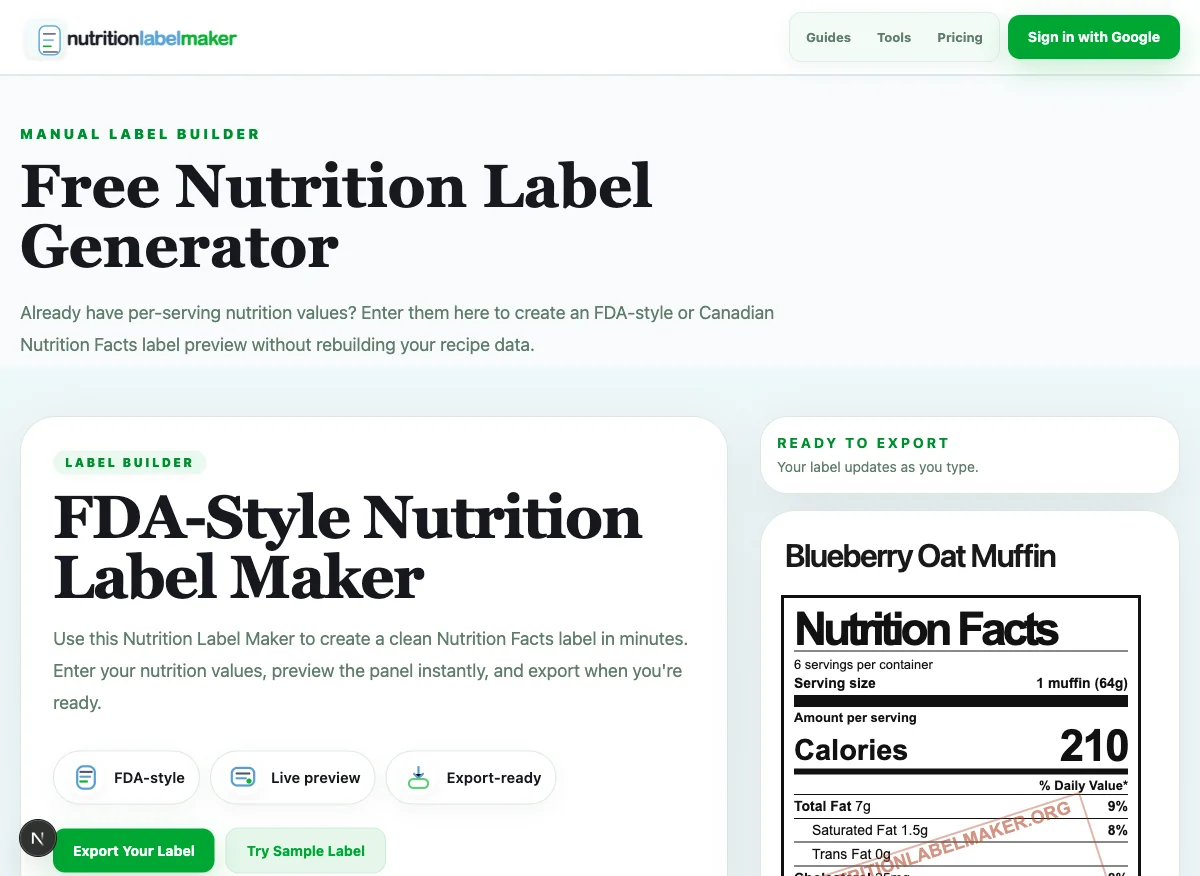
Actual product UI: final review surface
Actual current product UI: use the label preview after the source values and evidence path have been reviewed. The tool does not decide whether database analysis or laboratory testing is legally sufficient.
When laboratory analysis deserves priority
Laboratory review deserves more attention when the finished product may differ materially from the ingredient-level calculation. Examples include substantial moisture loss or gain, fermentation, frying, cooking concentration, complex blends, meaningful batch-to-batch variation, or a process that changes nutrient availability or composition.
A lab result is still a sample of a product and a point in time. The team should document what was tested, how the sample represents production, which methods were used, and whether the recipe or process has changed since the test. A lab report strengthens the evidence path; it does not remove the need to review serving size, rounding, Daily Value calculations, claims, and the final package.
- Finished-product composition is not well represented by raw ingredient values
- The process creates meaningful moisture, concentration, or yield changes
- Product variability could move a nutrient across an important threshold
- A qualified reviewer recommends verification for the product or market
Claims change the review question
Ordinary label preparation and claim substantiation are related but different tasks. A nutrition or health claim can make a particular nutrient, serving condition, or threshold central to the marketing decision, so the team should review the claim requirements and the evidence supporting the exact product as sold.
Do not use a database or a lab report as a shortcut around claim-specific review. If the claim depends on a narrow margin, variable nutrient, or product state, pause and obtain qualified regulatory and laboratory guidance before publishing the claim or treating the label as final.
- Identify which nutrient and serving condition the claim depends on
- Check the claim against the current product and applicable FDA requirements
- Use stronger verification when a small value change could change the claim outcome
Compare database and lab results without forcing a false choice
The decision does not always have to be database or laboratory analysis. A team may use database analysis to model recipe changes, use supplier data to fill known inputs, and then use laboratory testing to validate a stable finished product. When results differ, investigate the input definitions, sample preparation, yield, serving basis, and analytical method before choosing which number to display.
Keep a dated record of the source, assumptions, calculations, lab report, and reviewer decision. That record makes it easier to reopen the work after a formula, supplier, process, serving, or claim change.
- Compare values on the same serving and product-state basis
- Check recipe yield, moisture, preparation, and unit conversions before comparing numbers
- Document why the selected source is appropriate for the current package
Use this five-step decision checklist
Start by describing the product as it will actually be sold and consumed. Then collect the formula, supplier records, batch yield, serving plan, and any claims. If the product is stable and the decision is ordinary label preparation, a documented database calculation may be a reasonable workflow starting point. If the product or claim has unresolved variability, arrange laboratory or qualified review before finalizing the values.
Once the source values are reviewed, the Nutrition Label Generator can help turn them into a panel preview. It does not calculate a recipe from missing inputs, certify a lab report, or decide which evidence path is legally sufficient.
- Describe the finished product, market, and serving basis
- Document formula, supplier, yield, process, and claim inputs
- Choose database analysis, laboratory analysis, or a staged combination
- Record the source and reviewer decision for every displayed value
- Prepare and review the Nutrition Facts label only after the source values are stable
Common mistakes
- • Treating a generic ingredient database value as if it were a test result for the finished product
- • Changing the recipe, process, or serving size without reopening the nutrition-data review
- • Assuming a lab report automatically proves that every displayed label value is correct
- • Using nutrition or health claims without checking the claim-specific requirements and source evidence
Review checklist
- • The recipe, ingredient specifications, yield, and serving assumptions are documented
- • The source for every displayed nutrient value is recorded and dated
- • Finished-product variability and meaningful process changes have been considered
- • Any nutrition or health claim is reviewed separately from ordinary label preparation
- • The final data source and label are reviewed by an appropriately qualified person
FAQ
Do I always need a lab test for a Nutrition Facts label?
Not every product needs the same evidence path. A documented recipe/database calculation may be a useful starting point for a stable formula, while finished-product testing or qualified review may be more appropriate when variability, process effects, claims, or source uncertainty could change the label decision.
Can I use a USDA or ingredient database to make a nutrition label?
Database values can support recipe analysis when the ingredient identity, quantity, preparation state, yield, and serving assumptions are documented. Do not treat a generic database entry as a finished-product lab result or automatic proof of compliance.
When should I test the finished product instead of calculating from ingredients?
Consider finished-product testing when cooking, drying, fermentation, concentration, complex ingredients, batch variation, or a claim makes the ingredient-level calculation less representative of the product customers buy.
Does a lab report guarantee that my Nutrition Facts label is compliant?
No. The report is one source of evidence. Serving size, rounding, Daily Value calculations, claims, ingredient and allergen statements, package presentation, and final regulatory review still need attention.
Official sources
Related guides
FDA Nutrition Label Requirements: What Small Food Brands Should Review
A practical review guide for understanding FDA-style Nutrition Facts label structure, nutrition label requirements, and common mistakes.
How to Calculate Nutrition From a Recipe
A practical guide for turning recipe ingredients, batch yield, and serving logic into per-serving nutrition values that are ready for label review.
How to Make a Nutrition Facts Label
A step-by-step guide for small food brands learning how to make a nutrition label and turn recipe data into a Nutrition Facts label preview.
Can a Small Food Business Be Exempt From a Nutrition Facts Label?
A practical guide to investigating a small business Nutrition Facts labeling exemption without treating it as a blanket exemption from food-label requirements.
How to Calculate Serving Size for Nutrition Labels
A practical FDA serving-size guide for turning a finished product, its category, and its real measurements into a review-ready label serving.
How to Choose a Nutrition Facts Label Format
A practical guide for comparing Nutrition Facts label formats before a food label moves into packaging review.