
Key takeaway
A useful ingredient list starts with the active formula and is reviewed for weight order, compound ingredients, and the rest of the package before export. A polished sentence alone is not evidence that the packaging is ready.
Start with the short answer: review ingredient order by weight
For a U.S. food-label ingredient list, the practical starting point is to review whether the ingredients are declared in descending order of predominance by weight. The ingredient used in the greatest amount belongs first, followed by the ingredients used in smaller amounts.
That is a formula-review question before it is a writing question. Do not assume the order in an internal spreadsheet, a purchasing list, or a previous package already reflects the order that should be reviewed for the current product.
- Use the active formula as the starting source
- Review the actual quantities rather than the order ingredients were typed into a recipe
- Treat formula changes as a reason to reopen the ingredient-list review
Turn the active formula into an ingredient-list review
A useful food label ingredient order review begins with a stable product formula and current supplier details. Teams need enough information to see each ingredient, the amount used, and the package-facing name that will be reviewed. Internal shorthand such as a supplier code or a brand nickname is not a substitute for that review.
For example, a hypothetical cookie formula that uses more wheat flour than sugar, and more sugar than butter, should not list butter first just because it appears first in a worksheet. The example is a review aid, not a reusable label declaration: the correct declaration for a real product depends on its actual formula and applicable requirements.
- Separate formula quantities from purchase or production notes
- Confirm names and component information with current supplier documentation
- Keep the statement tied to the same recipe version as the Nutrition Facts review
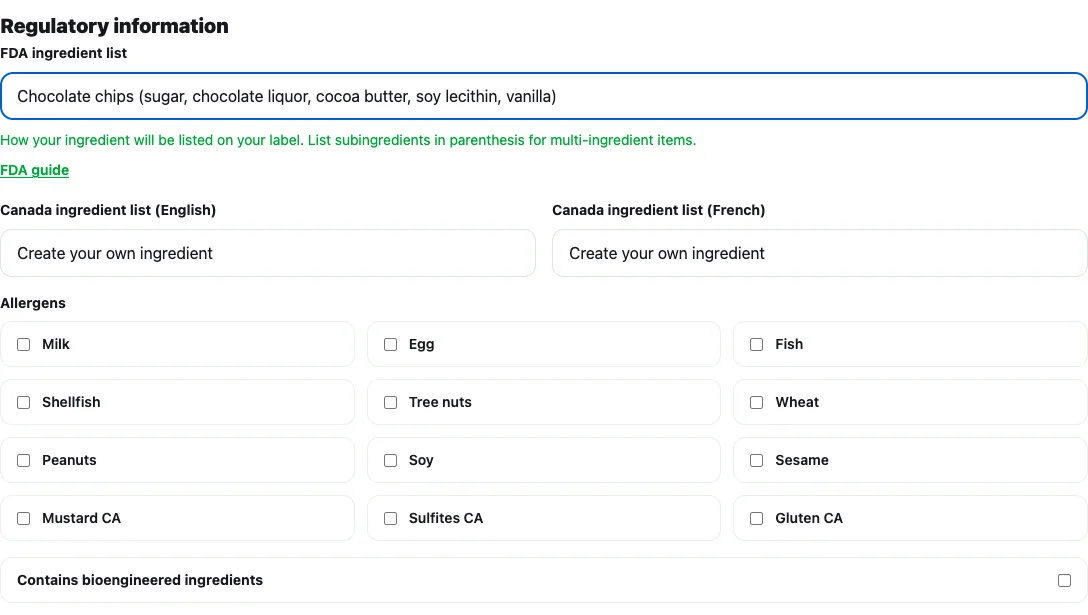
Actual FDA ingredient-list entry screen
Use the current formula and supplier details to review the package-facing ingredient declaration. The sample chocolate-chip text is illustrative only and was not saved to the workspace.
Review compound ingredients and subingredients separately
Compound ingredients create an extra review step. A chocolate chip, seasoning blend, sauce, or premix can have its own component ingredients, so the team needs to identify that parent ingredient and review the applicable way its subingredients are declared.
Do not turn this into a guessing exercise based on a supplier brand name. Keep the supplier specification available, compare it with the active formula, and use the official source and a qualified reviewer to confirm the declaration approach that applies to the product.
- Flag every purchased blend, sauce, chip, coating, or premix for component review
- Check whether the supplier's current specification has changed since the last package review
- Review subingredients before treating a short ingredient line as finished
Treat “Contains 2% or Less of” as a specific review question
A statement such as “Contains 2% or Less of” is not a formatting shortcut for any ingredient that feels minor. It is a separate rule question with conditions, and it should be checked against the current formula and applicable official requirements before it is used on packaging.
The safer workflow is to keep small-quantity ingredients visible in the review, document why the wording is being considered, and ask the appropriate qualified reviewer to confirm the final declaration for the product and market. Do not use the phrase to avoid reviewing weight order or compound ingredients.
- Keep small-quantity ingredients in the active formula review
- Do not assume every ingredient below a chosen threshold can be grouped the same way
- Recheck the wording when the formula, supplier, or market changes
Review the ingredient list beside allergen details and the label preview
Ingredient order is only one part of the packaging review. The ingredient statement should be checked beside the allergen statement, the Nutrition Facts panel, and nearby package text so each element reflects the same current product version.
This is where a connected workspace is helpful. It does not replace professional regulatory review, but it can make formula changes, statement drafts, and the label preview easier for a team to compare before export.
- Compare ingredient wording with the current recipe and supplier details
- Review allergen details from the same formula snapshot
- Reopen the full packaging review after meaningful ingredient changes
Use a final pre-export checklist instead of relying on a polished draft
Before a package file moves forward, check that the ingredient list can be traced to the active formula, that the order and component details have been reviewed, and that related statements are not based on an older version. This catches the most common kind of packaging drift: a product changed, but the supporting text did not.
If the rule question is uncertain, stop at the review stage and consult current official guidance and an appropriately qualified person for the product and market. A tool can organize the work, but it cannot certify a package as compliant.
- Confirm the formula version and supplier specifications used for the review
- Check order, component details, and any small-quantity wording before export
- Keep the final compliance decision with the appropriate qualified reviewer
Common mistakes
- • Copying ingredients in the order they happen to appear in an internal recipe spreadsheet
- • Using internal ingredient shorthand or a supplier brand name instead of reviewing the package-facing declaration
- • Treating a compound ingredient as one unexplained item without checking its subingredients
- • Assuming a small amount may be moved anywhere in the list without reviewing the applicable rules
Review checklist
- • The ingredient source is the active formula and the current supplier information, not an older package
- • The team has reviewed whether the list reflects descending order of predominance by weight
- • Compound ingredients and their subingredients have been checked against the applicable declaration approach
- • Any 2% or less wording is reviewed as its own rule question, not used to skip statement review
- • The ingredient statement, allergen details, and label preview all reflect the same product version
FAQ
Do food label ingredients have to be listed by weight?
For the U.S. FDA context covered by this guide, ingredient-list review generally starts with descending order of predominance by weight. Use the active formula and current supplier information, then confirm the final declaration against applicable official requirements.
Can I keep a compound ingredient as one item on the ingredient list?
Compound ingredients create a separate declaration review because they can have component ingredients of their own. Review the current supplier specification and the applicable official requirements instead of relying on the ingredient's brand name or an old package.
What does “Contains 2% or Less of” mean on an ingredient list?
It is a specific declaration approach with conditions, not a blanket shortcut for arranging minor ingredients. Check the active formula and current official requirements before using it on a package.
Do I need to review ingredient order again after a recipe change?
Yes. A meaningful recipe, supplier, or quantity change can affect the ingredient-list review and related package statements. Recheck the statement with allergen details and the label preview before export.
Official sources
Related guides
How to Write an Ingredient Statement
A practical guide for turning the active recipe into a review-ready ingredient statement that stays aligned with the label and surrounding packaging text.
How to Write an Allergen Statement
A practical guide for drafting an allergen statement that stays aligned with the current recipe, ingredient statement, and label review workflow.
FDA Nutrition Label Requirements: What Small Food Brands Should Review
A practical review guide for understanding FDA-style Nutrition Facts label structure, nutrition label requirements, and common mistakes.
How to Calculate Nutrition From a Recipe
A practical guide for turning recipe ingredients, batch yield, and serving logic into per-serving nutrition values that are ready for label review.
What Is a Net Quantity Statement? A Practical Guide for Food Labels
Net quantity is the amount of product in one retail package. Keep it separate from the serving plan, servings per container, and total recipe yield.