
Key takeaway
A label serving starts with the food category and its FDA reference amount, then has to be checked against the size, weight, and form of the finished product customers actually buy.
Start with the finished food, not the ingredient list
A serving-size review should begin with the food your customer buys and eats. A cookie, sauce, snack mix, beverage, or prepared meal may contain familiar ingredients, but its label category should describe the finished product rather than one ingredient inside it.
For U.S. Nutrition Facts labels, FDA reference amounts are organized by food category. That makes category selection a classification step: read the category description and examples, then decide whether they describe your product as sold and consumed. Do not choose a category only because a word in its name happens to match an ingredient.
- Describe the finished product in the form customers receive it
- Compare category descriptions and examples before using a reference amount
- Confirm the intended consumer audience before relying on a category reference
Use RACC as the category-level starting point
RACC means Reference Amount Customarily Consumed. It is an FDA reference amount associated with a food category, not a statement of how much an individual person should eat. The reference gives a structured place to start when reviewing the serving information for a Nutrition Facts label.
The next step is to translate that category-level amount into a serving expression that makes sense for the product in front of you. FDA serving-size information uses an appropriate common household measure, such as a cup, tablespoon, piece, slice, or jar, followed by a metric amount. The exact expression needs to reflect the actual food format.
- Use the applicable RACC category as a reference point, not a nutrition recommendation
- Keep the household measure and the metric amount together during review
- Escalate unusual products, exemptions, or category uncertainty for qualified review
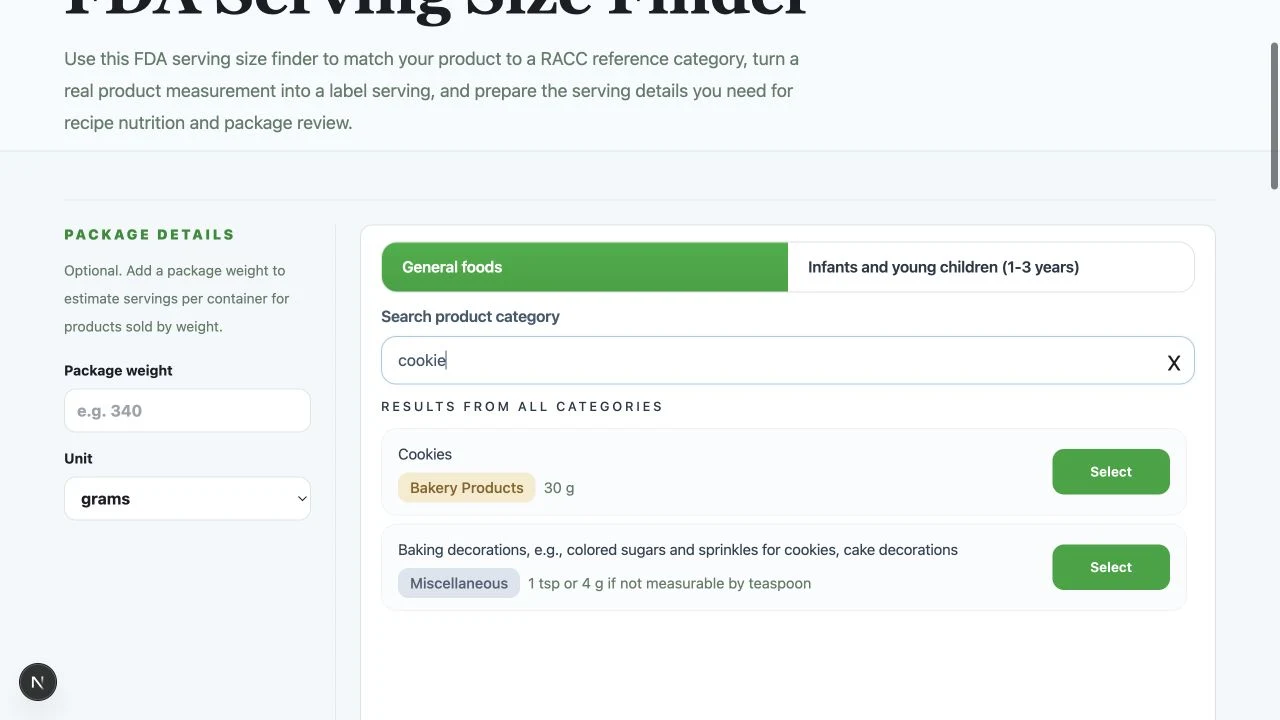
Step 1: match the finished food to a category
Start by searching for the finished food as customers buy it. The result separates Cookies from a similarly named baking-decoration category, which is why category selection cannot be based on a single ingredient word.
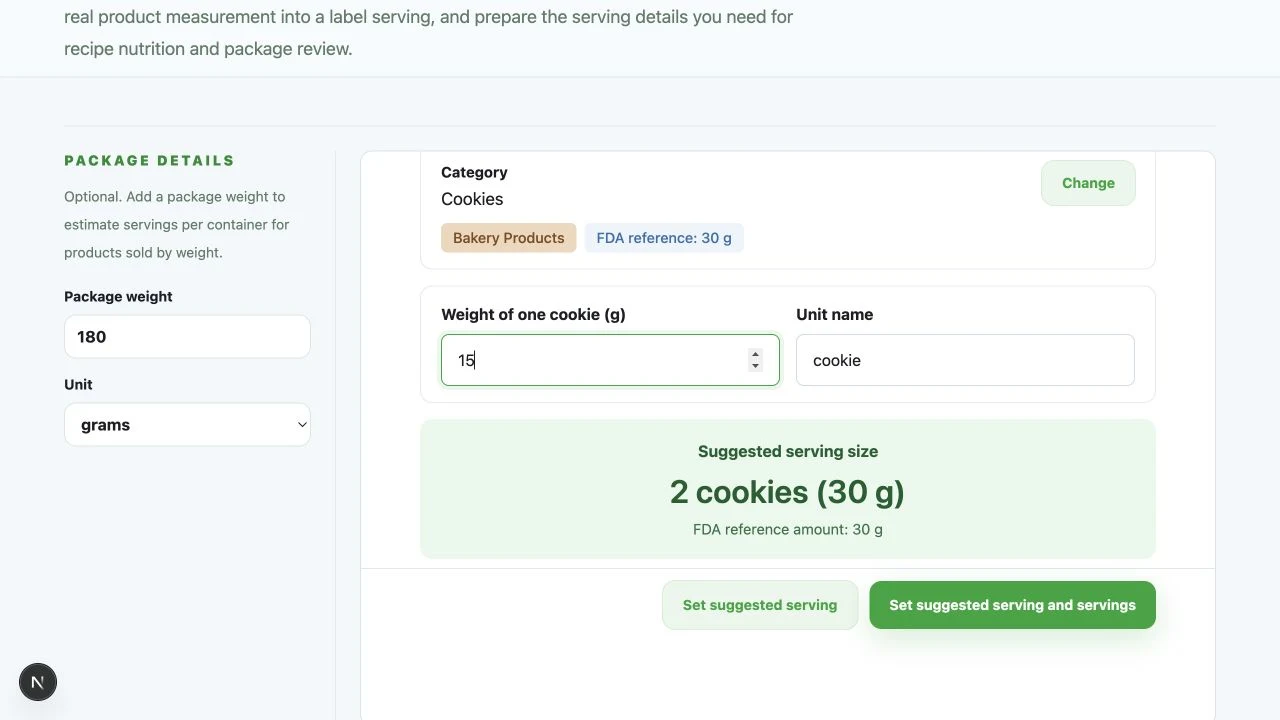
Step 2: measure the product and review the result
After choosing the category, use the measured finished product to turn the 30 g category reference into a serving expression that fits the product being sold.
Measure the finished product before choosing the household serving
The FDA reference amount does not know whether your cookie is 15 grams or 30 grams, whether your sauce is sold in a jar or a pouch, or how much one scoop of your finished product weighs. That is why a real finished-product measurement is needed before a household serving can be reviewed with confidence.
For a piece-based food, weigh one finished piece and use that measurement to see how many pieces approach the category reference. For foods measured by cups, spoons, or fluid ounces, measure the prepared product in the unit the label will use. Use production-ready samples where possible, because recipe yield, moisture, fill level, and product size can change the result.
- Weigh or measure the finished product rather than relying on an early recipe estimate
- Use a household measure customers can recognize for that food format
- Repeat the measurement when product size, density, or package format changes
Recheck the nutrition math and package count
Serving size affects the denominator for the Nutrition Facts panel. Once the serving decision changes, recalculate or recheck the per-serving calories and nutrient values before treating the panel as ready for review. A nutrition calculation based on an old serving plan can look internally consistent while describing the wrong portion.
For products sold by weight, divide the actual package quantity by the serving weight to estimate servings per container, then review the resulting package statement with the product's real fill and packaging plan. A package-size change can therefore trigger both a servings-per-container review and a per-serving nutrition review.
- Keep the serving decision connected to the recipe or source nutrition values
- Recheck servings per container after a package weight or fill change
- Review the label panel, ingredient statement, and allergen details from the same active product version
Common mistakes
- • Choosing a category from an ingredient name instead of the finished food as sold and consumed
- • Treating a RACC reference as the final household serving without measuring the actual product
- • Changing the serving size without rechecking per-serving nutrition and servings per container
Review checklist
- • The food category describes the finished product as it is sold and consumed
- • The RACC reference is checked against the product and the intended consumer audience
- • The household measure and metric amount are based on a real finished-product measurement
- • Per-serving nutrition and servings per container are rechecked after the serving decision
FAQ
What does RACC mean on a Nutrition Facts label?
RACC means Reference Amount Customarily Consumed. It is an FDA category-level reference amount that helps start a serving-size review; it is not a personalized nutrition recommendation.
Can I choose a serving size from my package size alone?
No. Package size can affect servings per container, but serving-size review should begin with the applicable finished-food category and then use real product measurements to check the household and metric serving expression.
Why do I need the weight of one cookie or bar?
The weight of one finished piece helps translate a category-level reference amount into a practical number of pieces and a metric serving weight for the product you actually sell.
Does a serving-size finder make my label compliant?
No. It can organize a RACC-guided starting point, but you remain responsible for confirming the final category, product facts, exemptions, and labeling requirements that apply before production.
Official sources
Related guides
How to Choose a Nutrition Facts Label Format
A practical guide for comparing Nutrition Facts label formats before a food label moves into packaging review.
FDA Nutrition Label Requirements: What Small Food Brands Should Review
A practical review guide for understanding FDA-style Nutrition Facts label structure, nutrition label requirements, and common mistakes.
How to Calculate Nutrition From a Recipe
A practical guide for turning recipe ingredients, batch yield, and serving logic into per-serving nutrition values that are ready for label review.
How to Make a Nutrition Facts Label
A step-by-step guide for small food brands learning how to make a nutrition label and turn recipe data into a Nutrition Facts label preview.
Canadian Nutrition Facts Label Guide
A practical guide for reviewing Canadian Nutrition Facts table work alongside ingredient, allergen, and packaging statement details.